 ultimate-guide
Why Premium Dog Beds Last Longer: A 2026 Guide
Table of Contents
- Why Premium Dog Beds Last Longer: The Construction Difference
- The Best Material for a Durable Dog Bed
- How Long Do Dog Beds Last? Lifespan by Size and Use
- How to Make a Dog Bed Last Longer
- When to Replace a Dog Bed
- Warranty, Repairability, and Total Cost of Ownership
- Conclusion: Choosing a Bed Built to Last
- Frequently Asked Questions
Last Updated: October 5, 2026
Why Premium Dog Beds Last Longer: The Construction Difference
A premium dog bed lasts longer because it uses denser foam, stronger fabric, and reinforced stitching that resist the daily compression and abrasion that destroy budget beds within months.
Most dog beds fail from the inside out: the cover looks fine while the foam underneath has collapsed into a lumpy pancake.
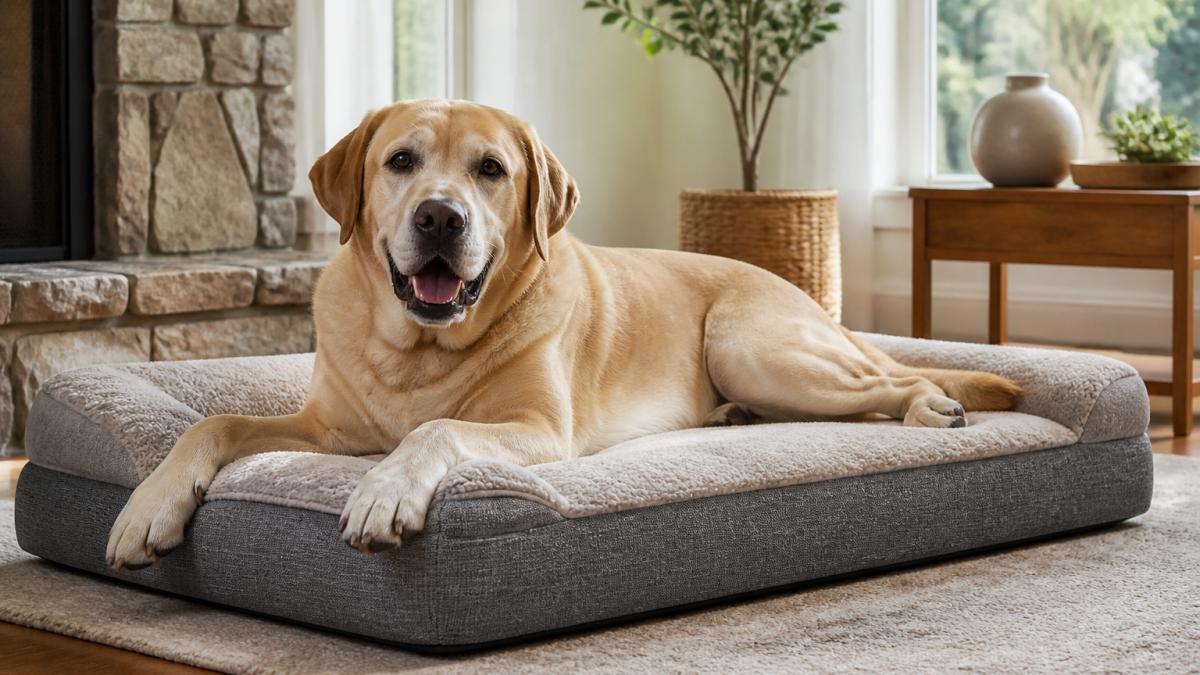
Foam Density and Support That Resists Sagging
Foam density, measured in pounds per cubic foot, determines how well a bed holds its shape under a dog's weight.
Memory foam adds pressure relief for older dogs or large breeds prone to joint stiffness. The trade-off is cost and weight. A common mistake is buying a bed with "memory foam" in the name that contains only a thin top layer over cheap filler.
Fabric Strength and Reinforced Seams
Fabric strength comes down to weave tightness and fiber type. Tear-resistant fabric like ballistic nylon or heavy-duty canvas withstands digging and scratching that shreds thin polyester covers.
What most guides miss is that abrasion resistance matters more than thickness: a thick but loosely woven cover wears through faster than a tighter, thinner weave. Stitching at the corners and zipper line is where cheap beds fail first.
The Best Material for a Durable Dog Bed
The best material for a durable dog bed combines a high-density foam core with a tightly woven, removable cover and a waterproof liner underneath. Each layer handles a different threat: foam resists sagging, the cover resists tearing, and the liner blocks spills from reaching the core.
For heavy chewers and diggers, look for beds with no exposed zippers or loose fabric edges. For senior dogs, prioritize orthopedic support and pressure relief over chew resistance. Hypoallergenic materials help dogs with skin sensitivities.
- Foam core: high-density or memory foam, resists compression
- Cover: tear-resistant canvas or ballistic nylon, removable and washable
- Liner: waterproof, protects foam from moisture and odor
- Base: non-skid bottom keeps the bed from sliding on hard floors
How Long Do Dog Beds Last? Lifespan by Size and Use
How long a dog bed lasts depends on four compounding variables: the dog's weight and how it distributes it, the dog's behavior (chewing, digging, nesting, drooling), the environment, and the quality of the foam core and cover.
The table below gives realistic ranges for a well-built bed with a high-density foam core, a tightly woven removable cover, and a waterproof liner.
| Dog Profile | Expected Lifespan | Primary Wear Mechanism |
|---|---|---|
| Small, calm dog (under 25 lb) | 5-8 years | Cover fading, slow foam compression |
| Medium dog, average use (25-60 lb) | 3-5 years | Foam softening at the hip and shoulder contact points |
| Large dog, heavy use (60-120 lb) | 2-4 years | Foam compression, seam stress at entry points |
| Giant breed (over 120 lb) | 1.5-3 years | Deep foam compression, cover abrasion |
| Chewer or digger | 6-18 months | Cover tears, seam blowouts, exposed core |
| Senior or arthritic dog | 3-5 years | Foam compression from prolonged single-position use |
| Multi-dog household (shared bed) | 1-2 years | Doubled load cycles, doubled abrasion |
| Outdoor or covered-patio use | 1-3 years | UV degradation, humidity, temperature swings |
Why the Ranges Overlap
A 90-pound dog that sleeps 14 hours a day on the same spot puts roughly the same compression load on a bed as a 130-pound dog that uses it intermittently.
This is why two owners with similar-sized dogs report wildly different lifespans: the dog that circles, digs, and repositions wears the cover faster, while the dog that flops down and stays put wears the foam faster.
Behavior Multipliers
- Diggers abrade the cover with every paw stroke. Tightly woven ballistic nylon or heavy canvas resists this for years; loose-knit polyester fails in months.
- Chewers attack seams, zippers, and tags first. Hidden zippers and no loose fabric edges help, but no fabric is chew-proof.
- Nesters push and bunch the fill, separating foam layers and creating permanent low spots.
- Droolers and incontinent dogs introduce moisture. Without a waterproof liner, it reaches the foam core, breaking down cell structure and creating odor that cannot be washed out.
Environment Multipliers
- Direct sunlight degrades foam and fabric. A bed in front of a south-facing window fails faster than one in a shaded room.
- Humidity accelerates foam breakdown and encourages mildew in the core.
- Hard floors transmit more vibration and friction to the base, wearing the non-skid layer and bottom fabric.
- Crates and tight spaces force entry and exit at the same stress point, concentrating seam wear.
How to Read These Numbers
Treat the ranges as a planning tool, not a warranty. If your dog fits two rows, say, a 70-pound digger, use the shorter range. If it fits none cleanly, default to the medium-dog row and adjust down for any behavior or environment multiplier.
The practical takeaway: a premium bed for a small, calm dog can last most of its adult life, while one for a large digger in a multi-dog household is still a 1-2 year purchase.
How to Make a Dog Bed Last Longer
Making a dog bed last longer comes down to protecting the foam, cleaning the cover properly, and reducing daily wear. A few habits add years to a good bed's life.
- Use a waterproof liner to keep accidents and drool out of the foam
- Wash the removable cover on a gentle cycle and air-dry it to protect the fabric
- Rotate the bed periodically so wear spreads evenly instead of concentrating in one spot
- Vacuum the cover between washes to remove grit that acts like sandpaper on fibers
When to Replace a Dog Bed
Replace a dog bed when the foam no longer springs back, the cover has tears exposing the core, or your dog avoids lying on it. A flattened bed offers no orthopedic support or pressure relief.
Watch for these signals:
- Foam stays compressed after you press it and does not recover
- Visible sagging or a permanent dip where your dog sleeps
- Torn fabric, exposed stuffing, or broken zippers
- Persistent odor that survives cleaning
That last one matters most. Dogs are honest about comfort. If a dog that used to love its bed starts sleeping elsewhere, the bed has failed.
Warranty, Repairability, and Total Cost of Ownership
Most buying guides stop at the sticker price, but the number that matters is cost per year of usable life, calculated from four inputs: purchase price, expected lifespan, replacement-part costs, and warranty coverage.
The Cost-Per-Year Framework
Cost per year = (purchase price + care costs over the period − warranty recoveries) ÷ years of usable life.
A budget bed that needs replacing every 9 months costs more per year than a premium bed at three to four times the price that lasts four years, and the gap widens when you factor in replacement shopping, waste, and the stretch when the foam has flattened but the owner has not yet replaced it.
Run the comparison over five years, long enough to capture at least one full replacement cycle for a budget bed and often zero for a premium bed in a small-dog household.
What Warranties Actually Cover
Warranty language separates premium brands from each other and budget brands tend to be silent. Read the terms before buying, and look for these clauses:
- Defect coverage, protects against manufacturing failures like seam separation, zipper failure, or a cover that shrinks out of fit after a normal wash. The most common warranty type.
- No-sag or compression guarantees, a narrower promise that the foam core will not lose a defined percentage of its loft within a stated period. Rare, and the strongest signal a brand stands behind its foam.
- Exclusions, almost every warranty excludes chewing damage, normal wear, fading, and improper washing. If your dog is a chewer, assume the warranty will not cover the failure you are most likely to see.
- Claim requirements, many brands require the original receipt, a photo of the defect, and sometimes the bed returned at the buyer's expense. A technically generous warranty that is hard to claim has little value.
Repairability as a Lifespan Extender
A bed with replaceable parts can outlive its original cover by years. Look for:
- Removable, individually sold covers, the highest-value feature for extending bed life. A worn cover is the most common failure point, and replacing it costs a fraction of a new bed.
- Replacement foam inserts, less common, but useful when the cover is fine and the foam has compressed.
- Replacement liners, cheap to stock and easy to swap when waterproofing fails.
- Standard zippers and hardware, a local tailor or upholstery shop can often replace a failed zipper for far less than a new bed, if it is a standard size rather than a proprietary design.
A bed with none of these features is a single-use product; one with all of them can be maintained almost indefinitely as long as the structural foam holds up.
The Waste Angle
Every budget bed replaced is a full bed sent to landfill, foam, fabric, zipper, and all. Most municipal waste systems do not recycle mixed-material bedding, so the realistic end-of-life path is the trash.
This is not a marketing angle, it is a consequence of the cost-per-year math. The features that make a premium bed cheaper over time also make it lower-waste.
Conclusion: Choosing a Bed Built to Last
The gap between a bed that lasts months and one that lasts years comes down to foam density, fabric strength, and construction quality, not brand name alone. Understanding why premium dog beds last longer lets you judge a bed on what is inside it rather than what the label claims.
At Dog Products and More, our curated selection and fast online experience deliver reliable, cost-effective supplies without the guesswork.
Shop Now
Frequently Asked Questions
Why do premium dog beds last longer than cheaper ones?
Premium dog beds last longer because they use high-density foam that resists sagging, tear-resistant fabrics with reinforced seams, and removable, washable covers. Budget beds often rely on low-density filling that flattens within months and thin fabric that rips at stress points. The upfront cost is higher, but the bed holds its shape and support for years instead of needing replacement every 6 to 12 months.
Are expensive dog beds worth the money?
For most dog owners, yes. A premium dog bed typically lasts 2 to 4 years or longer with proper care, while a budget bed may need replacing every 6 to 12 months. Over that span, the total cost of ownership often favors the premium option, especially for large dogs or heavy daily use. You also avoid the hassle of repeated shopping and disposal.
How long do dog beds last with heavy use?
Lifespan depends on materials, dog size, and behavior. Budget beds used daily by a large dog may last only 6 to 12 months before sagging or tearing. Premium beds with high-density foam and durable covers often last 2 to 4 years, and some reach 5 to 7 years with light use and regular cleaning. Dogs that chew or dig will shorten any bed's lifespan.
When should I replace my dog's bed?
Replace the bed when the foam no longer springs back, the cover has irreparable tears, or your dog avoids it. Visible sagging, flattened loft, or a persistent odor after washing are clear signs. If your dog is older or has joint issues, replace sooner rather than later, since lost support can worsen comfort and mobility.