 Listicle
Petco Alternatives for Premium Dog Beds in 2026
Last Updated: November 24, 2026
Quick Summary
Premium dog beds differ from cheaper ones mainly in foam density, support layer thickness, the base, and the cover, not simply in price. Compare these specifics, measure your dog stretched out with 6 to 8 inches added, and match the bed to your dog's age and joint needs.
- Ask for foam density and support-layer thickness, since orthopedic labels alone are only marketing claims.
- Measure your dog from nose to base of tail and add 6 to 8 inches.
- Prioritize a non-slip base so arthritic dogs do not have to brace on hard floors.
- Choose a waterproof liner for dogs with incontinence to protect the foam from moisture and odor.
- Wash covers monthly, air the foam quarterly, and never machine dry a foam bed on high heat.
Table of Contents
- What Makes a Premium Dog Bed Worth the Price
- Orthopedic Dog Bed Features to Compare
- Durable Dog Beds for Large Breeds: Sizing and Construction
- Washable Dog Bed Covers and Long-Term Maintenance
- Premium Dog Bed Alternatives Compared by Price and Style
- Choosing Your Next Premium Bed from Dog Products and More
- Frequently Asked Questions
Dog owners searching for a Petco alternative for premium dog beds are usually not unhappy with Petco. They are looking for a wider range of construction, clearer sizing, and beds built for a specific dog rather than a general one. At Dog Products and More, we have put together this guide to help you compare options on the features that actually affect comfort, support, and lifespan. The aim is to give you a clear framework so you can judge any bed on the same terms.
A premium bed is not simply a bigger price tag. The real differences show up in the foam, the cover, the base, and the stitching, and those are the details this guide focuses on when comparing premium dog beds.
What Makes a Premium Dog Bed Worth the Price
Most shoppers want to know whether spending more actually gets them something. The honest answer depends on the dog. A senior dog with stiff joints benefits far more from high-density support than a young terrier that sleeps curled up on the couch.
Start with three questions. How much support does your dog need? How often will the cover need washing? How much room does your dog need to stretch out? Your answers will narrow the field quickly.
Watch out: buying a bed that is too small is one of the most common mistakes. Measure your dog from nose to base of tail, then add 6 to 8 inches so the dog can stretch fully.
Orthopedic Dog Bed Features to Compare
Orthopedic beds are built to relieve pressure on joints and the spine, but the term is used loosely in marketing. Two beds labeled "orthopedic" can differ by several inches of foam and by whether the support layer is memory foam, high-density polyurethane foam, or a foam-and-gel composite. The features below are the ones that actually change how a bed performs, and they map to specific health conditions rather than to a general "senior dog" label.
Foam density and thickness. Support comes from density, not from the word "orthopedic." A high-density base resists bottoming out under a large dog's hips; a low-density topper feels soft on day one and compresses within months. Ask for the foam density in pounds per cubic foot and the thickness of the support layer separately from any comfort topper. A common pattern is a 3- to 4-inch high-density base with a 1- to 2-inch memory foam or gel topper, which balances pressure relief with shape retention. For whether this investment is worthwhile for a young dog, read whether orthopedic dog beds are worth it for puppies.
Bolster and edge support. A raised bolster gives a dog something to lean against, which helps with balance and with the feeling of security. For dogs with hip dysplasia or rear-limb weakness, a low, firm bolster along one side is often more useful than a deep surround, because the dog can still step in and out without lifting its hindquarters over a wall.
Non-slip base. A bed that slides on hardwood or tile forces a dog with arthritis to brace and scramble, which is exactly the motion the bed is supposed to reduce. Look for a textured or rubberized base, and check that it stays put on the floor surface in your home.
Waterproof liner. For dogs with incontinence or frequent accidents, a waterproof liner between the foam and the cover protects the support layer from moisture, odor, and mildew. A liner that can be wiped or machine washed separately extends the life of the foam considerably.
Breathable surface and cooling layers. Dogs that run warm, and dogs on certain medications, benefit from a breathable mesh or gel layer that moves heat away from the body. This matters most for double-coated breeds and for dogs that sleep in one spot for long stretches.
Condition-to-feature matrix. The table below matches common conditions to the features worth prioritizing. It is a starting point for a conversation with your veterinarian, not a diagnosis.
| Condition or need | Priority features | What to avoid |
|---|---|---|
| Arthritis | High-density base, low firm bolster, non-slip base | Deep soft foam that bottoms out |
| Hip dysplasia | Thick support layer, low entry height, edge support | High walls the dog must step over |
| Anxiety or restlessness | Bolster on one or more sides, snug fit | Oversized flat mats with no edge |
| Incontinence | Waterproof liner, removable washable cover | Foam with a sewn-in, non-removable cover |
| Heat sensitivity | Breathable mesh, gel layer, elevated frame | Heavy, non-breathable fabrics |
| Post-surgery recovery | Firm flat support, easy-clean cover, low profile | Beds that require lifting the dog in |
Watch out: a bed marketed as orthopedic with no stated foam density or support-layer thickness is a claim, not a specification. Ask for the numbers before you compare prices, and if your dog has a diagnosed condition, confirm the choice with your veterinarian.
For owners comparing a mat-style bed against a bolster, our guide on how to choose a memory foam dog mat for joint comfort walks through the trade-offs in more detail.
Durable Dog Beds for Large Breeds: Sizing and Construction
Large breeds put far more stress on a bed than smaller dogs do. Look for a stated weight capacity, tear-resistant or chew-resistant fabric, and reinforced stitching at the seams. A bed rated for the wrong weight will flatten and sag quickly.
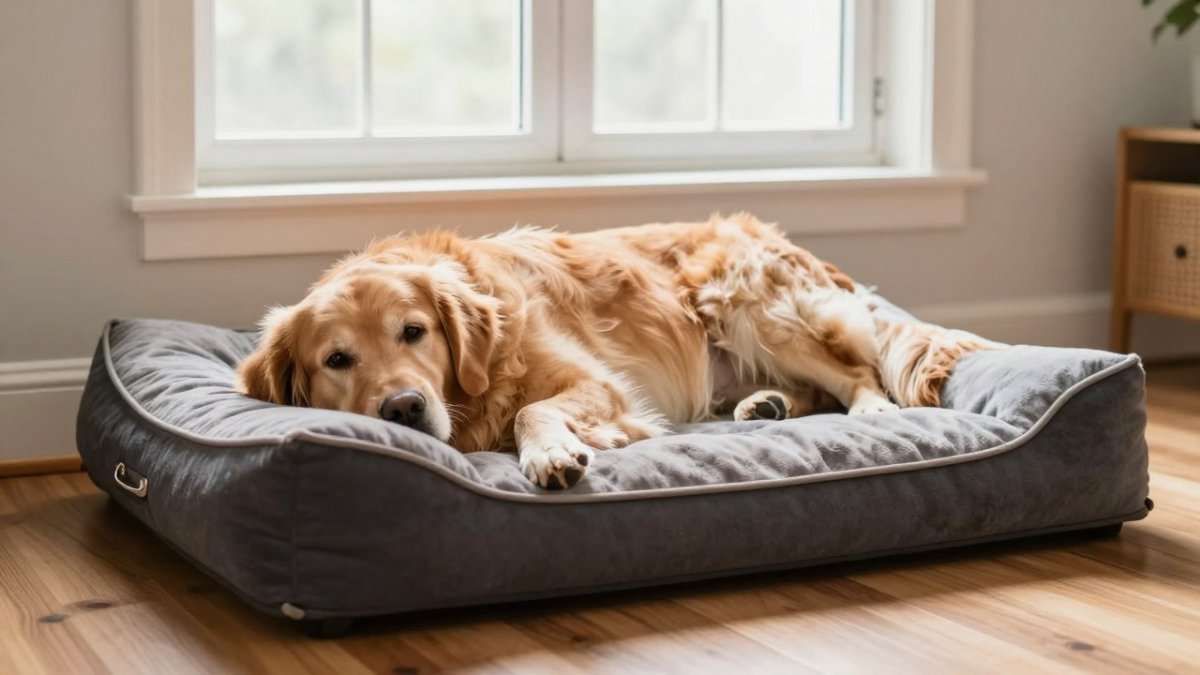
Sizing matters as much as strength. Measure the length your dog needs when stretched, not when curled. Many large-breed owners also prefer a bed with a removable cover and a supportive base so the bed keeps its shape. For tested, specific recommendations, see tested durable dog beds for large breeds.
Pricing depends on size, quantity, and delivery options, so visit our website for current prices or a quote.
Washable Dog Bed Covers and Long-Term Maintenance
A washable cover is one of the most useful features in a dog bed, but only if it is easy to remove and the rest of the bed survives the wash cycle. The maintenance steps below go beyond the usual "machine wash cold" advice and cover what actually determines whether a premium bed lasts three years or ten.
Cover removal and washing. Check that the cover zips off completely, that the zipper is covered so it does not rub, and that the fabric is machine washable. Wash on a gentle cycle with a mild detergent and no fabric softener, which can coat the fibers and reduce breathability. Air dry the cover when possible; if you use a dryer, use the lowest heat setting.
Foam care and restoration. Foam loses loft over time, but a few habits slow that down. Rotate the bed and flip the foam insert every few months so weight is distributed evenly. Air the foam out of direct sunlight after washing the cover, since trapped moisture is what causes odor and mildew. If the foam has compressed in one spot, a replacement insert from the manufacturer is usually cheaper than a new bed and restores most of the support.
Odor removal. For lingering odor, sprinkle baking soda on the foam, let it sit for several hours, and vacuum it off before replacing the cover. For urine, a enzyme-based cleaner applied to the waterproof liner and the foam surface, followed by thorough drying, is more effective than detergent alone. Never seal a damp foam insert back inside a cover.
Cover replacement sourcing. Zippers, seams, and binding are the first parts to fail. Before buying any premium bed, confirm whether the manufacturer sells replacement covers separately and at what price. A bed with a replaceable cover can outlast two or three covers, which changes the long-term cost comparison considerably.
End-of-life recycling and repurposing. Most guides stop at purchase, but a premium bed has a second life. Foam inserts can often be cut down for a smaller dog's crate or donated to a local shelter if the cover is still intact. Textile recycling programs accept fabric covers in some areas, and some foam manufacturers take back inserts. Check local recycling rules before putting a bed at the curb, since foam and mixed fabric are not accepted in most curbside programs.
Watch out: never machine dry a foam-filled bed on high heat. Heat breaks down the foam cells and shortens the bed's usable life, and it can also shrink or warp a cover that fit correctly before washing.
A simple maintenance schedule keeps a premium bed in service longer: wash the cover monthly, air the foam quarterly, rotate the insert every few months, and inspect seams and zippers each time the cover comes off.
Premium Dog Bed Alternatives Compared by Price and Style
Premium beds come in many styles. Sofa-style and furniture-grade beds suit owners who want a bed that blends into the living room. For a concrete option in this price range, see the cooling gel memory foam dog bed for medium dogs with a washable cover. Orthopedic memory foam beds prioritize support over looks. Elevated and cooling designs suit dogs who run warm.
Prices vary widely, so compare the features that matter most for your dog. Here is a simple way to think about the options:
| Bed Style | Best For | What to Check |
|---|---|---|
| Orthopedic memory foam | Senior dogs, joint support | Foam density, non-slip base |
| Furniture-style sofa bed | Owners who want home decor fit | Cover fabric, removable cushion |
| Elevated large-breed bed | Large dogs, warm climates | Weight capacity, frame strength |
| Cooling gel foam | Dogs that overheat at night | Breathable cover, gel layer |
Best for: owners who want a specific style or support level rather than a generic bed. Skip if: your dog is young, light, and happy on a basic cushion.
Choosing Your Next Premium Bed from Dog Products and More
Choosing a premium bed comes down to matching support, construction, and size to your dog. Start with your dog's age, weight, and sleeping habits. Then check the cover, the base, and the weight rating before you compare prices.
At Dog Products and More, we offer a curated selection of beds, grooming tools, toys, and essential accessories. If you are ready to compare, you can browse our elevated large-breed bed for big dogs or read our guide on how to choose a memory foam dog mat for joint comfort before you decide.
If you still have questions about fit or durability, our team can help you pick the right bed. Shop Now.
Frequently Asked Questions
Who makes the highest quality dog beds?
Quality depends more on construction than on brand name. Look for high-density foam or orthopedic memory foam cores, double-stitched seams, and covers that unzip for washing. The right bed is the one that matches your dog's size, sleeping habits and joint needs. Check the materials and dimensions listed on each product page before you buy, and compare the price against the features you actually need.
Is the Casper dog bed worth the money?
Before deciding, confirm the current price, dimensions and warranty terms on the manufacturer's site. Compare its listed features against an orthopedic option at a similar price point to judge whether it offers value for your dog.
How do I choose the right size bed for a large breed dog?
Measure your dog while it is lying on its side, from nose to base of tail, and add several inches so it can stretch. Choose a bed whose interior measurements exceed that length and whose sides are low enough for your dog to step in easily. Large breeds need firm support that does not sag under their weight, so check the stated weight capacity and the foam density before ordering.
What features should I look for in a premium orthopedic dog bed?
Start with a supportive core, such as memory foam or high-density foam, that cushions pressure points around the elbows and hips. Bolsters or raised edges help older dogs rest their heads, and a non-slip base keeps the bed from sliding on hard floors. A removable, washable cover and a waterproof liner make upkeep easier. Pricing varies with size and materials, so contact Dog Products and More for current prices or a quote.