 how-to
How to Choose Where an Adopted Dog Sleeps the First Night
Last Updated: October 26, 2026
Quick Summary
An adopted dog sleep should happen in a quiet, den-like crate or small enclosed space near you, not a big open room. A smaller space helps a newly adopted dog sleep because it feels secure, not exposed. Place the crate in your bedroom or a hallway near you, away from foot traffic.
- A rescue dog should sleep in a crate the first night in most cases for safety and routine.
- The 3-3-3 rule gives 3 days to decompress, 3 weeks to settle, and 3 months to feel at home.
- Take your dog out right before bed, even if they went an hour ago.
- Wait 30 to 60 seconds before responding to night crying so the dog can self-soothe.
- Keep a new rescue dog and a resident dog in separate sleeping zones for at least the first week.
Table of Contents
- Setting Up a Den-Like Sleeping Area Before Your Adopted Dog Sleeps
- Should a Rescue Dog Sleep in a Crate the First Night?
- Crate Training vs. Free Roaming: Pros and Cons for Night One
- The 3-3-3 Rule for Adopted Dogs and What It Means at Bedtime
- How to Help a Rescue Dog Sleep at Night: Routine, Potty Breaks, and Comfort Items
- Rescue Dog Crying at Night: What to Do About Whining and Pacing
- Sleeping Arrangements for Multi-Pet Homes and Breed-Specific Needs
- Shop Beds and Comfort Items for Your Adopted Dog's First Night
- Frequently Asked Questions
Setting Up a Den-Like Sleeping Area Before Your Adopted Dog Sleeps
Where should an adopted dog sleep first night? In a quiet, den-like crate or small enclosed space near you, not a big open room. A smaller space helps a newly adopted dog sleep because it feels secure, not exposed.
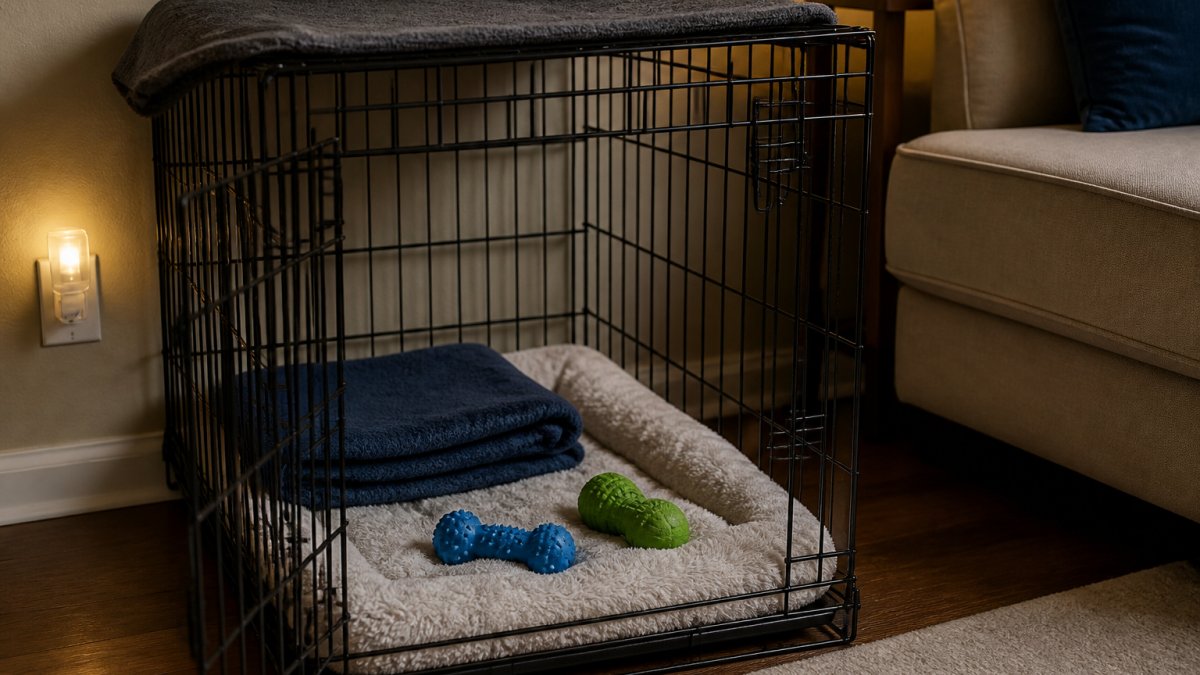
Dogs are den animals by instinct. A tight, covered spot lowers stress and gives a rescue dog one safe place to retreat to during the confusing first days after a shelter transition.
Start with these basics:
- A crate sized so your dog can stand, turn, and lie flat
- A washable pad or bed inside, plus one familiar-smelling blanket
- A cover over the top and sides to make it cave-like
A common mistake is buying the biggest crate available, too much room feels like a cage, not a nest. Block off extra space with a box if needed, and browse washable crate pads and sleeper cushions to make the den comfortable before your dog arrives.
Should a Rescue Dog Sleep in a Crate the First Night?
Yes, a rescue dog should sleep in a crate the first night in most cases.
Crate training takes time. Some rescue dogs arrive comfortable in a kennel; others have never seen one. Watch for stress signals, panting, drooling, pacing, trying to bolt.
Positive reinforcement works best: toss a treat inside, leave the door open, and let your dog explore at their own pace.
Crate Training vs. Free Roaming: Pros and Cons for Night One
Crating wins for night one in most homes, but free roaming has a place:
| Factor | Crate | Free Roaming |
|---|---|---|
| Safety for a new dog | High | Low until house-trained |
| Chewing and destruction risk | Low | High |
| Ease of house training | Easier | Harder |
| Comfort for anxious dogs | High when den-like | Mixed |
| Best for | Most rescue dogs, night one | Calm, house-trained dogs |
When Free Roaming Makes Sense
Free roaming can work if your dog is already house-trained, calm, and older. A senior dog who sleeps through the night may do fine on a bed in your room. Puppies and adolescent dogs? Crate them. The risk of chewed wires or accidents is too high on night one.
A middle path helps: a small gated area or a pen with a bed inside, room to move, but contained.
The 3-3-3 Rule for Adopted Dogs and What It Means at Bedtime
The 3-3-3 rule says a rescue dog needs 3 days to decompress, 3 weeks to settle into a routine, and 3 months to feel fully at home. At bedtime, it sets what to expect each night.
- Days 1-3: expect restlessness, whining, and clingy behavior. Keep things quiet and predictable.
- Weeks 1-3: your dog starts to learn your schedule. Bedtime gets easier.
- Months 1-3: a real sleep cycle returns. Your dog relaxes in their space.
This is a behavioral adjustment, not a test. A dog who cries for three nights is not broken. They are decompressing from a shelter transition. Give it time.
How to Help a Rescue Dog Sleep at Night: Routine, Potty Breaks, and Comfort Items
A bedtime routine is the single best tool for helping a rescue dog sleep at night. Dogs relax when they know what comes next. Keep the order the same every night: potty, water, a short calm walk, then into the crate with a treat.
Bedtime Routine and Potty Breaks
Take your dog out right before bed, even if they went an hour ago, nerves make dogs drink and pee more, and a 10 p.m. potty break can save a 2 a.m. cleanup. Keep indoor potty trays and cleanup supplies on hand for middle-of-the-night accidents. Keep it boring: no play, no chat, just business, then back inside.
Night Lights, White Noise, and Calming Pheromones
Small comforts go a long way for a nervous dog:
- A dim night light so the room is not pitch black
- A white noise machine or fan to muffle strange house sounds
- A calming pheromone diffuser or spray near the crate
These are not gimmicks. They mimic the calm, familiar feel of a cozy nest and help your dog's sleep cycle settle.
Rescue Dog Crying at Night: What to Do About Whining and Pacing
Rescue dog crying at night is expected in the first few days, but "expected" is not the same as "ignore it" or "panic." The useful skill is telling three cries apart, because each calls for a different response.
Three Kinds of Night Crying
- Settling-in whining (days 1-7): short bursts, often at bedtime or when you leave the room, that taper within 10-20 minutes. The dog is decompressing from a shelter transition and testing whether you come back. Normal.
- Distress crying: continuous, escalating, often paired with panting, drooling, pacing, scratching at the crate door, or attempts to bolt. The dog is panicking, not settling, this needs a different response than "wait it out."
- Pain or medical crying: sudden onset, often after the dog has been quiet, sometimes paired with restlessness, heavy or fast breathing, licking a specific body part, or reluctance to lie down. A newly adopted dog may have an untreated ear infection, dental pain, kennel cough, or a GI issue from transition stress. If it looks like pain rather than loneliness, call your vet.
A Response Sequence That Does Not Reward Chaos
- Wait 30-60 seconds before responding. Give the dog a chance to self-soothe. Rushing in at the first whimper teaches that crying summons you.
- Respond calmly and quietly. Low voice, no eye contact if the dog is frantic, no opening the crate door while the dog is lunging or scratching at it.
- Sit beside the crate until the dog lies down. Your presence is the comfort; the door stays closed. Leave once the dog is settled, even briefly.
- Take a boring potty break if you suspect a real need. Leash on, out to the same spot, no play, no chat, back inside. A puppy or a nervous dog may genuinely need to go once or twice in the first nights.
- Never yell, bang on the crate, or spray the dog. Aversive responses build fear of the crate and make night two worse.
When It Is More Than Settling In
Normal settling-in crying often fades noticeably within 7-10 nights and is largely gone by the three-week mark. Use that as a rough yardstick, not a hard rule:
- Crying that is improving night over night, even slowly, is on track. Keep the routine steady.
- Crying that is unchanged or worse after 10-14 nights, or that only happens when you leave the room and stops the moment you return, points toward separation anxiety rather than settling-in, a behavioral issue, not a discipline issue.
- Crying paired with house soiling, destructive chewing directed at exits, drooling, or attempts to escape is a red flag for true separation anxiety and warrants a call to your vet or a certified behavior consultant.
A dog who cries every night for weeks is not "being stubborn." Talk to your vet first to rule out pain or illness, then ask for a referral to a veterinary behaviorist or certified applied animal behaviorist if the pattern persists.
Sleeping Arrangements for Multi-Pet Homes and Breed-Specific Needs
Most guides treat the first night as a single-dog problem. In reality, the two situations that derail night one fastest are a resident pet who already owns the bedroom and a dog whose breed or age changes what "comfortable" means. Handle both before lights out.
Multi-Pet Homes: The Separate-Space Rule
A new rescue dog and a resident dog should not share a bed, crate, or sleeping area on night one, even if they got along fine during a daytime meet-and-greet. Sleep is when resources (space, your attention, the best cushion) get contested, and a dog still decompressing from a shelter transition has no established social contract with your resident pet.
Set up two distinct sleeping zones before your dog arrives:
- Separate crates or pens, ideally in the same room but with a visual barrier (a blanket over one side, a dresser between them) so each dog can settle without staring at the other.
- Separate water bowls placed on opposite sides of the room, so neither dog has to guard or share.
- Separate comfort items, do not hand the new dog the resident dog's favorite blanket. Scent-swap instead: give each dog a towel that smells like the other for a few days before introducing them to sleeping in the same room.
Introduce the two dogs during the day, on neutral ground, on leash, before putting them in the same sleeping room. A common pattern: the first night goes fine, and trouble shows up on night three or four when the new dog tests boundaries. Keep the separate-space rule for at least the first week, then transition slowly, side-by-side crates with a barrier, then crates with no barrier, then supervised free time together.
Breed and Age Change the Setup
Generic "medium crate, soft bed" advice fails a lot of dogs. Adjust the den to the dog in front of you:
- Flat-faced breeds (Bulldogs, French Bulldogs, Pugs, Boston Terriers): they overheat easily and breathe poorly in enclosed spaces. Skip the heavy crate cover, use a wire crate with open airflow on at least two sides, and keep the room cool. A covered crate can turn into a sauna.
- Giant breeds (Great Danes, Mastiffs, Newfoundlands): they need a crate sized to stand and turn without ducking, and a bed thick enough that joints do not bottom out on the floor. A too-small crate is a welfare problem, not just a comfort one.
- High-energy herding and working breeds (Border Collies, Australian Shepherds, Huskies): a single pre-bed walk often is not enough. These dogs need a real physical and mental drain in the two hours before bed, a training session, a puzzle feeder, a sniff walk, or they will pace and whine no matter how nice the crate is.
If your adopted dog is older or large, see our guide to the best orthopedic dog beds for senior dogs for sizing and support tips, and match the crate size to the dog's adult measurements, not to the puppy you think they might have been.
Shop Beds and Comfort Items for Your Adopted Dog's First Night
Set your new dog up for a calm first night with the right gear. Browse our large dog sofa bed with a washable cushion for a comfortable, easy-to-clean spot.
At Dog Products and More, we stock a curated range of beds, crates, and comfort items for rescue dogs of every size. Shop now and help your adopted dog settle in from night one.
Frequently Asked Questions
Should an adopted dog sleep in a crate the first night?
A crate is often the safest choice for the first night because it gives a newly adopted dog a den-like space that feels secure. If your dog was previously crated or kenneled, a crate with the door closed and a soft bed inside can reduce pacing and destructive chewing. If the dog shows panic, drooling, or frantic scratching at the crate door, switch to a gated pen or a small puppy-proofed room instead. The goal is calm, not confinement.
What is the 3-3-3 rule for adopted dogs?
The 3-3-3 rule is a common timeline for rescue dogs: three days to decompress, three weeks to settle into a routine, and three months to feel fully at home. During the first three days, keep things quiet and predictable, including where your adopted dog sleeps. Avoid introducing new pets, visitors, or long outings. Understanding this timeline helps you set realistic expectations for whining, pacing, and house training accidents during the first nights.
How can I help a rescue dog sleep at night without crying?
Build a short bedtime routine: a final potty break, a calm walk or quiet play, then lights down and a comfort item in the sleeping area. Place the bed or crate in a quiet spot near the family, use a night light and white noise to mask unfamiliar sounds, and avoid eye contact or lengthy reassurance if your rescue dog cries at night. Brief, calm check-ins work better than long conversations. Most dogs settle within a few nights once the routine is consistent.
Can my adopted dog sleep in my bedroom the first night?
Yes, many trainers recommend a bed or crate in the bedroom for the first few nights because your presence reduces nighttime anxiety and helps the dog settle. Keep the dog on a leash or in a crate beside the bed if you worry about chewing or accidents. If you prefer the dog to sleep elsewhere long-term, start with the crate in your room and move it gradually toward the door over one to two weeks. Consistency matters more than the exact location.
The first night with a rescue dog is rarely perfect, and that is okay. What matters is a safe space, a steady routine, and patience while your dog decompresses. Dog Products and More carries washable crate pads, den-style crates, and comfort items to make that transition easier. Get started with Dog Products and More and give your adopted dog the calm, cozy first night they deserve.